

KANGLONG DM-300: Engineering Analysis of DMR Tier II Direct Dual-Slot TDMA & Hardware AES 256 Encryption in Enterprise Fleets
Target Audience: Plant Operations Directors, RF System Engineers, Security Fleet Managers, Commercial Equipment Integrators
Have you ever wondered why even high-power analog transceivers struggle to maintain clear, uninterrupted communication across modern manufacturing plants, logistics warehouses, and high-density commercial complexes? In demanding day-to-day operations, enterprise fleet managers frequently run into three critical communication barriers: severe channel congestion during peak shift handovers, overwhelming background machinery rumble that drowns out vital spoken instructions, and the persistent vulnerability of unencrypted voice traffic to unauthorized scanning and eavesdropping.
When multiple maintenance, logistics, and emergency response teams must share a limited pool of assigned VHF/UHF analog frequencies, radio operators are forced to wait for open airtime. This channel contention leads to critical dispatch bottlenecks, unacknowledged alarms, and reduced operational throughput. Furthermore, legacy analog squelch circuits cannot differentiate between acoustic background noise and human voice formants, resulting in harsh squelch tails and unintelligible transmissions. In response to these operational pain points, the KANGLONG DM-300 DMR Digital Transceiver was engineered to unite professional-grade digital signal processing with rugged industrial hardware, delivering doubling of channel capacity without repeater hardware, military-grade voice privacy, and comprehensive remote fleet governance.
The KANGLONG DM-300 is an ultra-compact, commercial-grade DMR Tier II and analog dual-mode handheld transceiver built to meet rigorous industrial communications standards. Operating across the UHF 400–480 MHz frequency spectrum, the DM-300 integrates an advanced digital signal processing (DSP) core, an AMBE+2™ vocoder, and dual-slot Time Division Multiple Access (TDMA) architecture into a lightweight 95 × 56 × 32 mm industrial chassis.
Unlike legacy analog walkie-talkies that occupy an entire 12.5 kHz channel for a single voice stream, the DM-300 divides the RF carrier into alternating 30-millisecond time slots in strict accordance with the ETSI TS 102 361 DMR standard. This enables two simultaneous, fully independent voice or data conversations on a single licensed frequency in Direct Mode (simplex), without requiring an expensive base station repeater infrastructure.
| Category | Engineering Parameter | Specification Standard |
|---|---|---|
| RF Performance | Frequency Range & RF Power | UHF: 400–480 MHz | High: 2.0W / Low: 0.5W |
| Digital Protocol | DMR Tier II Standard & Vocoder | ETSI TS 102 361 | AMBE+2™ Acoustic DSP |
| Capacity | Channel & Zone Architecture | 128 Channels / 8 Zones (16 Channels per Zone) |
| Security | Hardware Voice Encryption | AES 256-bit (Enhanced 64-hex Key) & Analog Voice Inversion |
| Acoustics | Audio Output Power & Distortion | 1000 mW @ 8Ω Loudspeaker | Distortion ≤ 3% |
| Power & Ingress | Charging Interface & Operating Temp | USB Type-C Fast Direct Charge + Base | -40°C to +85°C |
Investing in professional radio fleet modernization is not merely about replacing legacy hardware—it is about establishing a resilient, secure, and cost-effective communication backbone that safeguards operational uptime and personnel safety. Here is why the technological design of the KANGLONG DM-300 delivers tangible ROI to commercial enterprises:
Deploying a fleet of DM-300 transceivers is engineered for rapid field onboarding. System engineers can follow this step-by-step framework using the dedicated Customer Programming Software (CPS):
Configure the target transmit (TX) and receive (RX) frequencies within the UHF 400–480 MHz range. Set channel spacing to 12.5 kHz for digital DMR channels (or 25 kHz / 12.5 kHz for hybrid analog channels).
Assign a Color Code (0 to 15) to separate co-channel digital networks. Next, designate the operational Time Slot (Slot 1 or Slot 2) for each talkgroup to enable two simultaneous direct conversations per frequency.
Program standard DMR call hierarchies: Group Calls (Team Dispatch), Private Calls (Point-to-Point 1-to-1 secure voice), and All Calls (Emergency plant-wide broadcast). Assign unique Radio IDs to all fleet units.
For secure enterprise talkgroups, enable AES 256 Hardware Encryption in the CPS. Enter the 64-character hexadecimal key across authorized radios and link the encryption key index to designated digital channels.
Map the programmable side button to essential short/long-press actions: High/Low Power (2W/0.5W), Zone Switching (up to 8 zones), Lone Worker safety timer, or Emergency One-Touch Alarm.
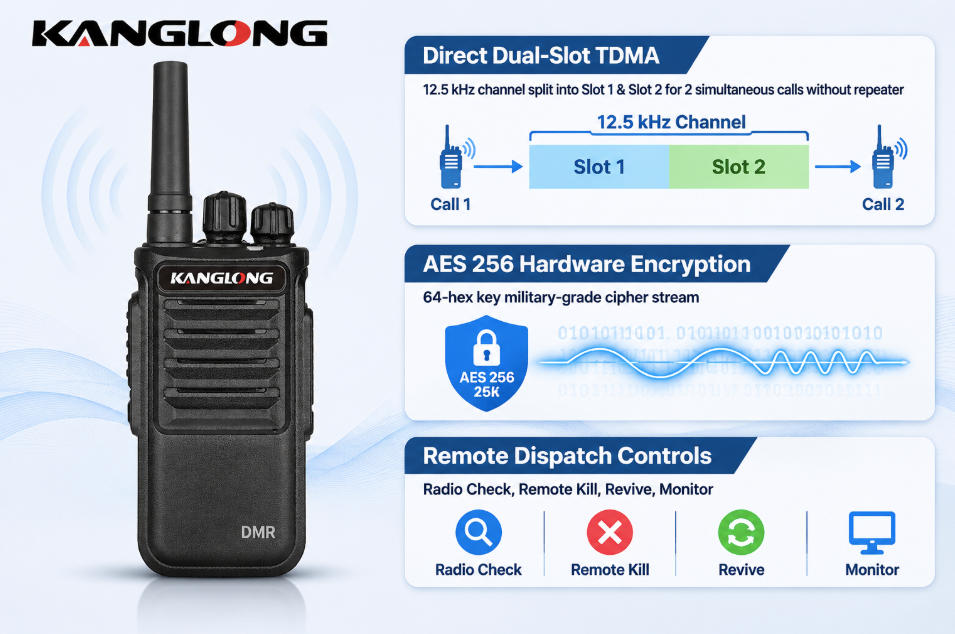
In traditional analog or FDMA radios, one physical RF carrier supports only one communication stream. DMR Tier II TDMA splits a 12.5 kHz carrier into two alternating 30 ms time slots. In Direct Mode (simplex), the DM-300 utilizes internal DSP timing synchronization to pulse transmissions accurately within its assigned slot. As a result, two separate conversation groups can talk simultaneously on the exact same frequency without interference or the need for a central synchronizing repeater.
Yes, fully. The DM-300 is a dual-mode hybrid transceiver supporting both DMR digital and legacy analog FM modulation. It features 50 CTCSS (QT) sub-audio tones and 105 DCS (DQT) digital coded squelch codes, alongside analog voice inversion scrambling. Enterprises can assign analog channels to specific zones to ensure seamless backwards compatibility while gradually transitioning fleet teams to digital DMR.
The DM-300 supports true AES (Advanced Encryption Standard) 256-bit hardware encryption, which utilizes a 64-hexadecimal character key to encrypt digitized voice payloads at the vocoder layer before RF transmission. Unlike basic privacy scramblers that merely invert analog frequencies, AES 256 is mathematically infeasible to decrypt via radio scanners or SDR tools, meeting the rigorous privacy demands of security details, banking institutions, and industrial IP protection.
When a radio is reported lost or stolen, a fleet dispatcher transmits a designated 5-tone/digital signaling packet containing the target radio's unique ID. Receiving a Remote Stun command disables the radio from transmitting while allowing monitoring; a Remote Kill command completely locks the transceiver hardware, preventing both TX and RX until an authorized Radio Revive command is transmitted. Remote Monitor enables supervisors to remotely open the target radio's microphone in emergency situations.
The DM-300 offers dual charging versatility: it includes a standard desk charging cradle for centralized shift stations, as well as a direct USB Type-C port on the battery base for fast charging via standard 5V wall chargers, power banks, or vehicle ports. Additionally, TDMA digital transmission consumes up to 40% less battery power than analog transmission because the transmitter is active only 50% of the time during speech bursts, easily covering 12-to-18-hour industrial shifts.
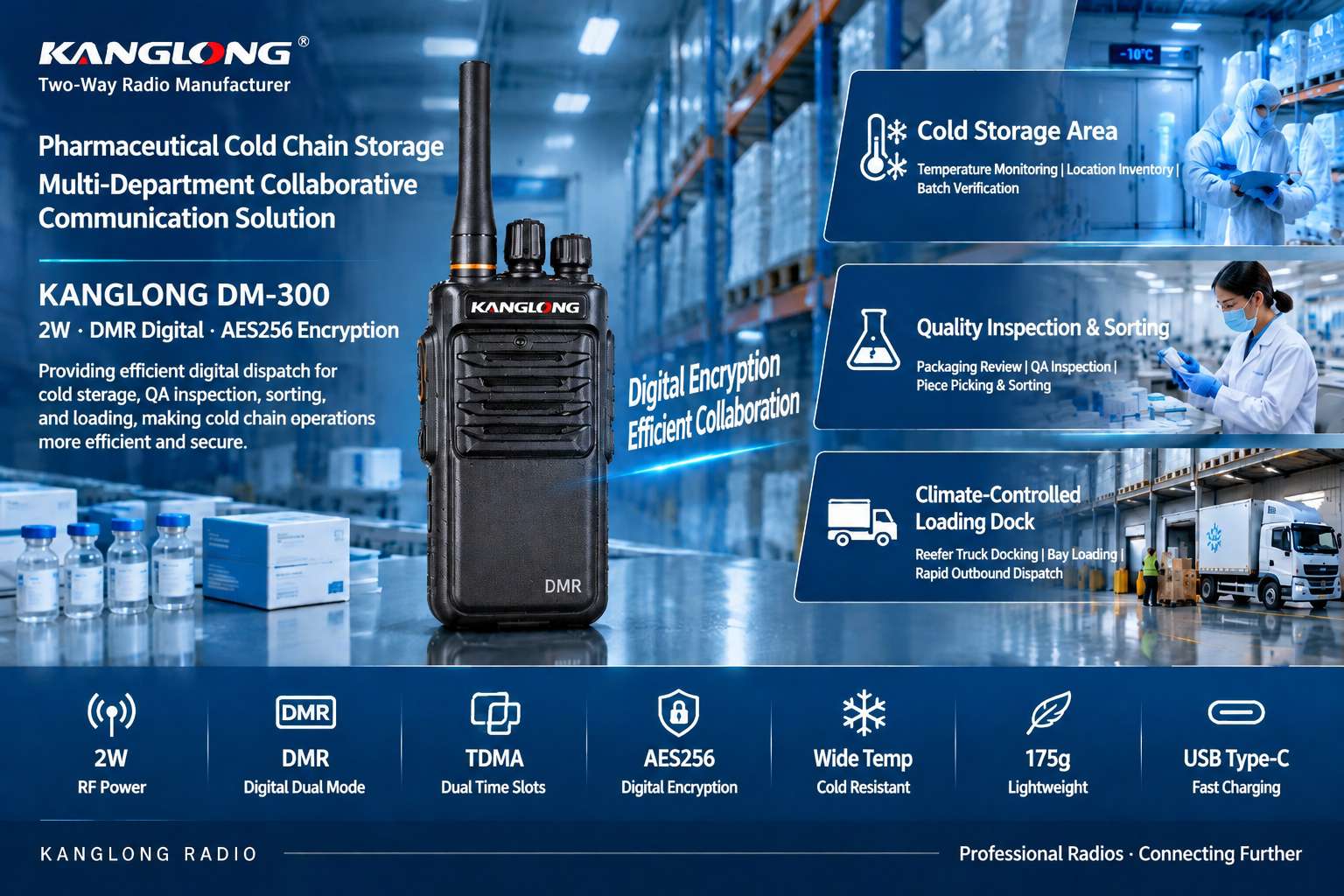
Engineered for harsh industrial deployments, the KANGLONG DM-300 operates reliably across an extended temperature range of -40°C to +85°C. The chassis features high-impact polycarbonate housing with sealed SP/MIC rubber gaskets to resist dust, moisture, and chemical exposure in steel mills, cold storage warehouses, outdoor construction sites, and maritime facilities.
Looking to modernize your industrial two-way radio fleet with crystal-clear AMBE+2™ audio, direct dual-slot capacity, and unbreachable AES 256 hardware encryption? Partner directly with KANGLONG for factory-direct customization, OEM/ODM solutions, and wholesale enterprise pricing.
Explore DM-300 on Official Website English
 عربي
 Русский
 Français
 Español
 Deutsch